Why an ANA Report Can Be Technically Correct but Clinically Useless
Explore why ANA reports may be technically accurate yet clinically non-informative, how structured ANA screening and profiling improves diagnostic decisions, and best practices for labs.
A senior laboratory director once said something that stayed with me:
“Nothing on the report was wrong.
And yet, no one knew what to do next.”
That statement captures a growing paradox in modern autoimmune diagnostics.
We are generating more data than ever — yet clarity is often what’s missing.
When a Positive ANA Creates Diagnostic Confusion
A middle-aged patient presents with photosensitivity, arthralgia, and fatigue.
The ANA screen is positive — expected.
To be thorough, a broad ANA panel is ordered.
The report comes back dense.
Multiple bands light up.
Individually, each marker is defensible.
Collectively, they tell no clinical story.
The clinician hesitates.
Referrals increase.
Repeat testing follows.
The patient waits.
Not because the disease is complex —
But because the diagnostic question was poorly framed.
How ANA-15 Profiling Converts a Positive ANA into a Definitive SLE Diagnosis
At some point, the laboratory stopped asking:
“What else can we test?”
And asked a far more disciplined question:
“Which antibodies actually explain this patient — right now?”
An ANA-15 profile was performed.
The result was immediate:
• dsDNA — positive
• Sm — positive
• Nucleosome — positive
Everything else was non-contributory.
The interpretation took minutes.
Systemic Lupus Erythematosus.
High specificity.
No hedging.
No escalation.
Why Fewer Markers Delivered More Clarity
ANA-15 didn’t reduce information.
It reduced noise.
Every antibody had a purpose:
• Confirm disease
• Support judgment
• Close the diagnostic loop
Nothing was included to appear comprehensive.
Nothing was added “just in case.”
That restraint is not minimalism.
It is diagnostic maturity.
Why ANA-15? Not ANA-18 or ANA-23
“Why not ANA-18?
Why not ANA-23?”
It’s the right question — and the answer matters.
The difference is not the marker count.
The difference is diagnostic intent.
Why Panels Don’t Compete. They Sequence.
ANA-15 answers a very specific question:
Is there a disease-defining autoimmune signal that explains this patient?
ANA-18 and extended profiles answer a different one:
What else could this be — when uncertainty genuinely remains?
The problem is not extended panels.
The problem is using them too early.
When deployed prematurely, broader panels often:
• Increase non-contributory positives
• Add interpretive burden
• Delay decisions rather than accelerate them
This is not a testing issue.
It is a strategy issue.
How Advanced Laboratories Actually Think?
Leading laboratories don’t ask:
“Which ANA panel is better?”
They ask:
“Which ANA panel is appropriate — and when?”
The most effective approach is tiered:
1️⃣ Start with disease-defining clarity
2️⃣ Escalate only if ambiguity persists
That sequencing protects:
• Diagnostic confidence
• Clinical trust
• Patient timelines
A Quiet but Powerful Insight
One lab director summarized it perfectly:
“ANA-15 didn’t tell us more.
It told us enough — at the right moment.”
What is Our Philosophy at Amindo Biologics
At Amindo, we don’t believe progress in diagnostics comes from adding markers indiscriminately.
We believe it comes from precision, restraint, and clinical relevance.
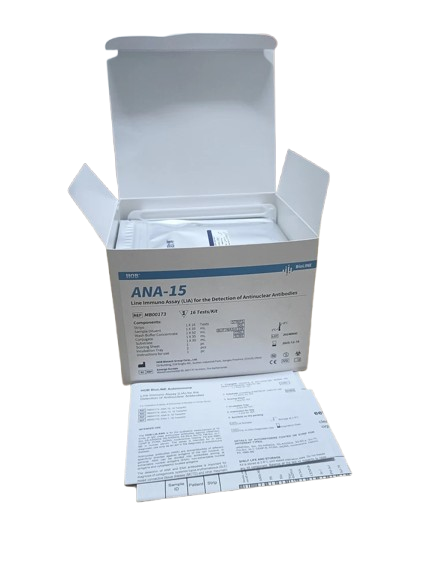
That philosophy is built directly into the Amindo ANA-15 kit.
The panel is deliberately curated to include only disease-defining, clinically actionable autoantibodies — markers that consistently support confident first-line interpretation rather than expand diagnostic possibility space.
Developed on line immunoassay technology, Amindo ANA-15 is optimized for:
• Clear band discrimination
• High specificity with minimal interpretive ambiguity
• Consistent, reproducible performance in routine laboratory workflows
It is not designed to impress with breadth.
It is designed to support judgment when decisions matter.
ANA panels do not diagnose disease.
Judgment does: The right panel simply has the discipline to support it.
At Amindo Biologics, we recognize that accurate autoimmune diagnosis depends on specificity, standardization, and clinical relevance.
The ANA 15 Line Immunoassay enables simultaneous detection of clinically significant antinuclear autoantibodies with high analytical performance, supporting structured interpretation in suspected systemic autoimmune disorders. Optimized for routine laboratory workflows, ANA 15 enhances diagnostic confidence while reducing interpretive ambiguity associated with broad ANA screening.