Why More Antigens Don’t Always Mean Better ANA Diagnosis
A senior pathologist once remarked during a case review:
“The problem wasn’t that the ANA was positive.
The problem was that it was too positive, and nobody knew what to do with it.”
The report came from a broad ANA panel. Multiple bands lit up. The clinician hesitated. The patient waited.
What followed was a cascade of referrals, repeat testing, and anxiety — not because the disease was complex, but because the diagnostic question was poorly framed.
This is where the discussion of ANA-15 vs ANA-18 truly begins — not as a marker-count comparison, but as a philosophy of autoimmune diagnostics.
The Silent Shift in Autoimmune Testing

Source: https://www.drhagmeyer.com/services/immune-testing/autoimmune-disease-testing-and-triggers/
Over the past decade, ANA testing has quietly shifted from:
“Is ANA present?”
to
“Which autoantibody profile actually explains this patient?”
Modern clinicians don’t need more data.
They need actionable discrimination.
In this context, the value of an ANA panel is no longer defined by how many markers it contains — but by how well it separates signal from noise.
ANA-15: The Discipline of Diagnostic Restraint
ANA-15 is often described as a basic or routine panel.
That description misses the point.
In reality, ANA-15 is deliberately restrained by design.
It includes only disease-defining autoantibodies:
- dsDNA, Sm, nucleosome, histone → SLE
- SSA (Ro-60), Ro-52, SSB → Sjögren’s spectrum
- Scl-70, CENP-B → systemic sclerosis
- Jo-1, PM-Scl → myositis and overlap syndromes
- AMA-M2 → autoimmune liver disease (PBC)
Every marker included answers a direct clinical question.
There are no antibodies whose primary role is exclusion, probability dilution, or academic completeness.
That is not a limitation. That is diagnostic discipline.
Why Most Autoimmune Workups Are Solved at This Level
In real-world laboratory practice, a significant proportion of autoimmune referrals present with:
- Defined clinical suspicion
- Structured symptomatology
- Clear pre-test probability
In such scenarios, ANA-15 resolves the majority of cases without escalation.
Extended profiles add value only when ambiguity remains, not as a default.
This is why experienced laboratories increasingly view ANA-15 as the workhorse panel — efficient, decisive, and clinically sufficient in most contexts.
ANA-18: When Confidence Matters More Than Confirmation
ANA-18 does not compete with ANA-15. It extends the diagnostic conversation.
The addition of DFS70, Mi-2, and Ku is not about finding more disease — it is about knowing when a diagnosis should not be made, or when deeper stratification is required.
- DFS70 reframes isolated ANA positivity, preventing over-diagnosis
- Mi-2 enhances certainty in dermatomyositis
- Ku refines overlap syndrome characterization
ANA-18 is not a first question. It is a second, smarter one.
Are Extended ANA Panels Truly Optimized for Complexity?
An important question often goes unasked:
Are all ANA-18+ panels available in the market genuinely optimized to differentiate complex, overlap-heavy autoimmune cases — or do they merely increase marker count without proportional diagnostic resolution?
In practice, adding more antibodies does not automatically translate into deeper clinical insight unless those markers are:
- Analytically optimized
- Clinically validated
- Interpreted within strict diagnostic context
Without this rigor, extended panels risk amplifying ambiguity rather than resolving it.
For this reason, many laboratories continue to rely on a well-curated ANA-15 profile as the most reliable foundation for autoimmune diagnosis — escalating only when clinical uncertainty genuinely persists.
The Marker That Doesn’t Diagnose — But Saves the Diagnosis
One of the most under-acknowledged realities in autoimmune testing is this:
False-positive ANA results create more downstream testing than missed positives.
Markers such as DFS70 are valuable not because they diagnose disease, but because they prevent unnecessary diagnostic escalation.
Their role reflects a mature understanding of modern immunology:
- Not every ANA positivity equals disease
- Not every band deserves clinical weight
Not every result should change management
Why DFS70 and Ku Are Not in ANA-15 — Intentionally
Their absence from ANA-15 is not an oversight.
ANA-15 is designed around disease confirmation, not exclusion.
DFS70 and Ku serve critical roles — but only when the clinical context demands deeper interrogation.
This distinction separates panel intelligence from panel inflation.
What Advanced Laboratories Are Doing Differently
Leading diagnostic laboratories are no longer asking:
“Which ANA panel is better?”
They are asking:
“Which ANA panel is appropriate — and when?”
Increasingly, the answer is a tiered strategy:
- ANA-15 for structured screening and routine autoimmune workups
- Escalation only when complexity truly warrants it
This approach improves:
- Diagnostic clarity
- Cost efficiency
- Clinician confidence
Amindo ANA-15: Designed for Real-World Diagnostic Practice
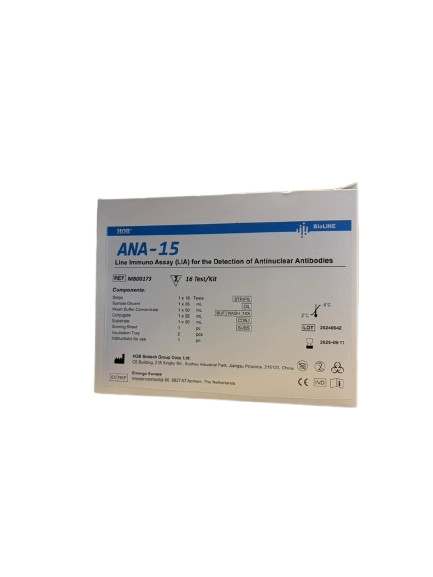
Amindo Biologics’ ANA-15 profile reflects this exact philosophy.
Rather than assembling a maximal marker list, the panel is curated to include only clinically actionable autoantibodies, ensuring:
- High diagnostic yield
- Minimal interpretive ambiguity
- Consistent correlation with disease phenotypes
Built on line immunoassay technology, Amindo ANA-15 delivers:
- Clear band interpretation
- High specificity
- Reproducible performance across batches
For laboratories that value precision over proliferation, ANA-15 is not just a screening panel — it is a diagnostic decision tool.
ANA panels do not diagnose diseases.
Judgment does: And often, the most powerful diagnostic decision is not to test further —
but to recognize when the answer is already clear.
Visit website to know more: https://amindobiologics.com/our-products/